


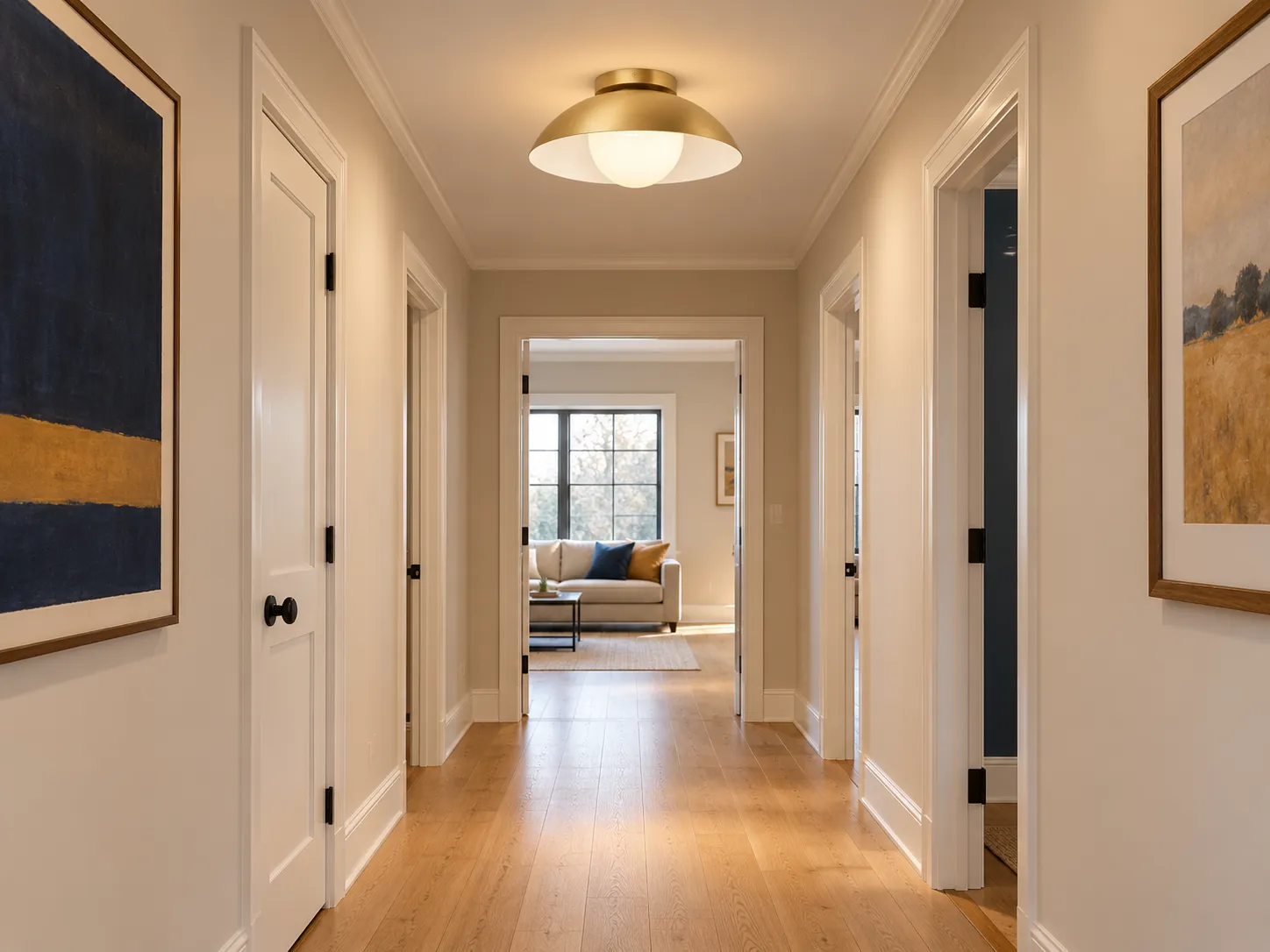
Hallway Lighting Guide
Hallway Lighting Ideas for a Brighter, Safer Passage
A hallway should be easy to navigate, but it can also feel like a considered part of the home. The aim is even light along the path without crowding a narrow space.
Good hallway lighting begins with the route people take. Measure the corridor width, ceiling height, and doors that swing into it. A decorative fixture should never make the passage feel less usable.
Measure the Passage and Door Swings
Note ceiling height, hallway length, and the distance between door frames. Open every door fully before choosing a projecting sconce or a hanging fixture. If the hall includes a step or stair landing, mark it as a priority for reliable illumination.
In a compact corridor, fixture projection matters as much as width. Read the product dimensions for how far a wall light extends from the wall and how far a ceiling light hangs below the ceiling.
Choose Ceiling Lights for an Even Path
A flush or semi-flush ceiling light can give a short hall general brightness without drawing attention to limited width. In a long corridor, multiple appropriately spaced sources often feel more even than a single bright fixture at one end. Check electrical box locations and the actual beam pattern before finalizing spacing.
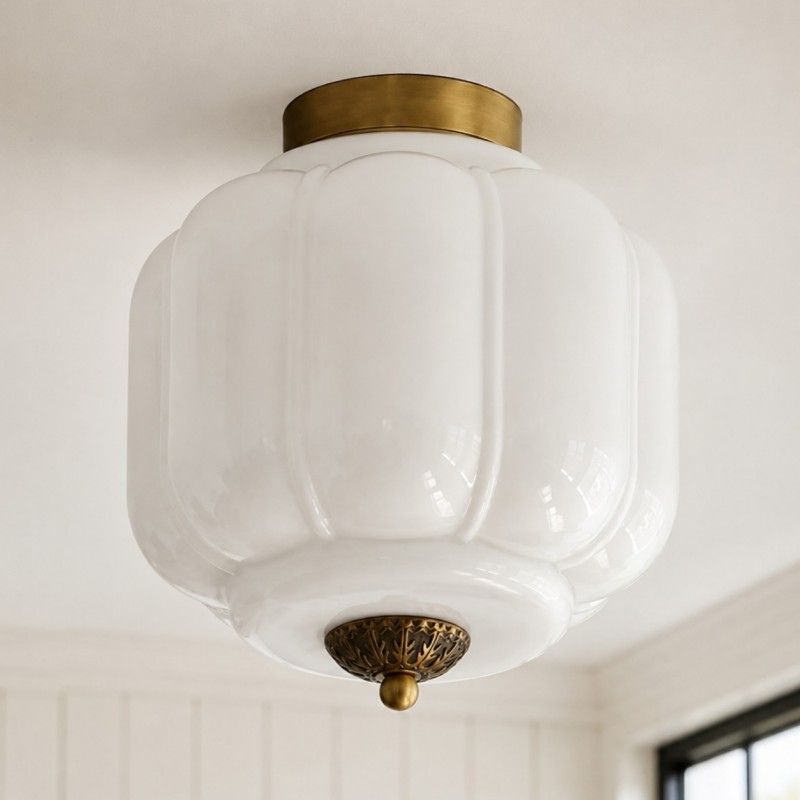
Browse ceiling lights for low-profile options, then confirm the installed depth and clearance.

Use Wall Lights Where They Add Value
A wall light can brighten artwork, a console, or an especially dark stretch of hallway. Mount it where the shade will not intrude into walking space or interfere with doors. From the approach, check whether an exposed bulb causes glare.
If the corridor is very narrow, a shallow wall fixture may be more appropriate than a large projecting shade. Its position should reflect your actual wall and furniture layout.
Make Everyday Use Easy
A hallway used between bedrooms and bathrooms may benefit from controls at both ends; ask a qualified electrician about suitable switching. Keep steps and turns visible after dark. If you use a sensor or smart control, make sure the setup behaves predictably for everyone in the household.
Coordinate the light color with adjacent rooms so the corridor does not feel disconnected. Exact matching fixtures are not necessary.
Avoid These Hallway Mistakes
- One light at a distant end: check for dark sections between doors.
- Deep sconces in a tight hall: confirm wall projection.
- Hanging too low: preserve headroom throughout the path.
- Overlooking switch access: consider how the hall is entered from either end.
Frequently Asked Questions
What lighting works in a narrow hallway?
Low-profile ceiling lights or shallow wall sconces are common options. Prioritize headroom, door clearance, and an even walking path.
How do I light a long hallway?
Several well-placed sources can reduce dark gaps. Final spacing depends on the fixture’s light distribution and the hallway layout.
Can I hang a pendant in a hallway?
Only where its installed drop preserves required clearance and does not interfere with doors or walking paths.
